
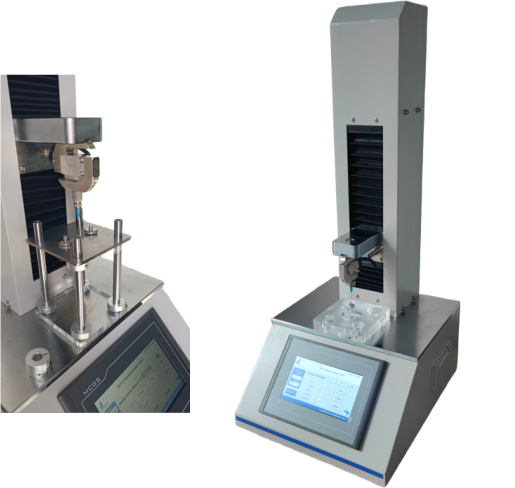

Needle Penetration Test Method

In the field of medical device quality control and pharmaceutical packaging, the needle penetration test method plays a pivotal role in ensuring the safety, functionality, and compliance of injection systems. Whether you are testing prefilled syringes, hypodermic needles, or specialized delivery systems, mastering this test method is crucial to meeting ISO 7864 and ISO 11040-4 standards.

Syringetest.com offers highly precise equipment for performing needle sharpness testing and penetrability tests, enabling our clients in packaging, pharmaceuticals, and healthcare industries to meet the highest international standards.

The Importance of Needle Penetration Testing

The needle penetration test method ensures:

  • Patient safety by verifying low-force, sharp needles.
  • Regulatory compliance with ISO 7864 and ISO 11040-4.
  • Quality control in syringe and needle production.
  • Consistency in penetration performance of siliconized coatings and needle designs.

What Is the Needle Penetration Test Method?

The needle penetration test method is designed to measure the force required to pierce a specified substrate with a needle under controlled conditions. The test mimics the mechanical behavior of needles during actual use and helps evaluate their sharpness, coating quality, and manufacturing consistency.

The outcome ensures that hypodermic needles and syringes comply with both ISO 7864 Annex D and ISO 11040-4 Annex F, which outline procedures, materials, and apparatus requirements for accurate and reproducible testing.

Penetrability Test and Needle Sharpness Testing in ISO Standards

ISO 7864: Penetrability and Drag Force

ISO 7864 Annex D outlines the penetrability test by simulating insertion into a material that resembles human or animal tissue.

  • Test principle: Insert the needle into a standardized substrate (e.g., latex rubber or polyurethane) at a constant speed (typically 100 mm/min).
  • Measurement targets:
    • Peak penetration force: The force needed to initially pierce the substrate.
    • Drag force: The average resistance force while the needle continues to move through the material.
  • Substrates used: Natural latex rubber, silicone rubber, polyethylene (LDPE), or polyurethane sheets with controlled hardness and thickness.

ISO 11040-4: Needle Penetration Force in Prefilled Syringes

Annex F of ISO 11040-4 focuses on testing glass barrels for injectables and subassembled syringes. It prescribes the needle penetration force test using a tension-free foil to simulate skin-like resistance.

  • Stages of force profile:
    • F0: Initial piercing force.
    • F1: Cutting force from the needle edges.
    • F2: Passage of the needle heel.
    • F3: Drag penetration force.
  • The method enables manufacturers to verify consistency across siliconized and non-siliconized needles and syringe types.

Step-by-Step Procedure for Needle Penetration Test

1. Condition Samples

Store needles and substrates at 18–28 °C and 25–75% RH for 24 hours before testing.

2. Mount the Needle

Align the needle perpendicular to the substrate using the holder.

3. Secure the Substrate

Fix into the holder with a visible and accessible 10 mm test zone.

4. Start the Test

Drive the needle into the substrate at the selected speed (e.g., 100 mm/min) to 80% of its length.

5. Measure Forces

Record the peak force and calculate the average drag force from the force vs. displacement curve.

6. Repeat Testing

Use a new substrate site for each needle to prevent interference.

7. Report Results

Include mean, standard deviation, and full force-displacement data.

Equipment Needed for Needle Penetration Testing

To perform the needle penetration test method accurately, you need:

  1. Universal Testing Machine
    • Load range: Up to 10 N, or suitable for expected forces.
    • Speed range: 20 mm/min to 200 mm/min, adjustable.
    • Sampling rate: ≥ 500 Hz for peak force tests.
  2. Needle Holder
    • Maintains vertical alignment.
    • Holds needles securely and reproducibly.
  3. Substrate Holder
    • Dual-plate system with 10 mm open test area.
    • Ensures uniform clamping force across samples.
  4. Test Substrate
    • Chosen based on simulation needs (e.g., latex, LDPE, silicone).
    • Must be fresh for each test to ensure result integrity.
Needle Penetration Test Method - Needle Sharpness Measurement

Why Choose Syringetest.com?

Syringetest.com specializes in customized testing equipment for penetrability tests, needle sharpness testing, and medical packaging applications. Our testing systems are:

  • Compliant with ISO 7864 & ISO 11040-4
  • Configurable for different substrates and sample types
  • Equipped with advanced force sensors and real-time data analytics
  • Suitable for R&D, QA/QC labs, and production environments

We offer tailored solutions for pharmaceutical companies, medical device manufacturers, and quality inspection agencies, helping you meet global regulatory requirements with precision and efficiency.

Mastering the needle penetration test method is essential for maintaining high standards in medical and pharmaceutical production. By understanding and following the requirements outlined in ISO 7864 and ISO 11040-4, manufacturers can ensure product safety, functionality, and regulatory compliance.

Syringetest.com is here to support your journey with expert testing systems, professional guidance, and customizable services tailored to your needs.

en_USEN