
Overview of Medical Syringe Piston Glide Force Testing
A medical syringe tester provides a controlled method for evaluating the mechanical performance of syringe pistons and plunger assemblies. One important application is the Syringe Piston Glide Force Test, which measures the force required to start and maintain piston movement inside the syringe barrel. This testing helps laboratories evaluate syringe sliding resistance, piston operating characteristics, and movement consistency.
For disposable syringes and pharmaceutical delivery systems, piston movement directly affects the force required to operate the syringe. Excessive initial resistance may make piston activation difficult, while unstable travel force can result in uneven piston movement. Therefore, measuring break-loose and travel force provides useful quantitative information for product development, quality control, and manufacturing verification.
What Is Syringe Piston Glide Force Testing?
Syringe Piston Glide Force Testing is a mechanical test that measures the force generated as the piston moves through the syringe barrel under controlled conditions.
The test focuses on the resistance between the piston stopper and the inner surface of the barrel. Depending on the test stage, the measured force can represent the resistance required to initiate piston movement or the resistance encountered while the piston continues moving.
The two most important characteristics are:
- Break-loose force – the force required to initiate piston movement.
- Travel force / glide force – the force required to maintain piston movement after it has started.
A force-displacement curve can show how the piston behaves throughout the movement. This allows engineers to identify excessive starting resistance, force fluctuations, or abnormal changes during piston travel.
In practical terms, the test evaluates whether the piston can move through the syringe barrel smoothly, consistently, and with an appropriate operating force.
Why Is Syringe Sliding Resistance Important?
Syringe sliding resistance is closely related to the mechanical behavior of the piston and barrel assembly. A syringe may meet dimensional requirements but still demonstrate undesirable piston movement if friction, sealing conditions, lubrication, or component tolerances cause excessive resistance.
A controlled Medical Syringe Sliding Resistance Test can help manufacturers investigate these factors.
Typical reasons for measuring piston sliding resistance include:
- Comparing different piston stopper materials
- Evaluating different barrel materials or surface conditions
- Studying the effect of lubrication
- Comparing syringe designs
- Monitoring production consistency
- Investigating excessive plunger force
- Supporting new product development
- Verifying incoming components
- Establishing internal quality-control criteria
For R&D engineers, the force curve can help compare different component combinations. For quality engineers, repeated force measurements can reveal changes between production batches.
Break-loose Force and Travel Force
The force required to operate a syringe is not necessarily constant throughout piston movement.
When the piston is initially stationary, a relatively high force may be required to overcome the initial resistance. Once the piston starts moving, the required force may decrease and then stabilize.
This creates two important areas for evaluation.
| Parameter | Meaning | Testing Significance |
|---|---|---|
| Break-loose Force | Force required to start piston movement | Indicates initial piston resistance |
| Initiating Force | Maximum force required to begin movement | Identifies the initial force peak |
| Peak Force | Highest force recorded during movement | Shows maximum operating resistance |
| Travel Force | Force required to sustain piston movement | Indicates continuous sliding resistance |
| Glide Force | Force associated with piston travel | Helps evaluate movement smoothness |
For example, a syringe could have a relatively high break-loose force but a relatively stable travel force after movement begins. Another syringe could have an acceptable initial force but significant force fluctuations during travel.
Therefore, evaluating only one force value may not fully describe syringe piston performance.
How Does a Syringe Piston Glide Force Test Work?
A typical test uses a medical syringe tester equipped with a suitable fixture, force measurement system, and controlled linear drive.
The general testing process includes the following steps:
1. Prepare the Syringe
The syringe, piston, and other required components are prepared according to the applicable test method. The specimen should be correctly assembled before testing.
2. Install the Syringe
The syringe barrel is securely positioned in the fixture. The piston and barrel should be properly aligned with the direction of the applied force.
Correct alignment is important because unwanted lateral forces can influence the measured result.
3. Set the Test Parameters
The operator selects the appropriate test speed, displacement, and other test conditions. The selected conditions should correspond to the applicable standard or validated laboratory procedure.
4. Apply the Force
The tester drives the piston through the barrel at a controlled speed while continuously measuring the applied force.
5. Capture the Initial Force
As the piston changes from a stationary state to a moving state, the tester records the force required to initiate movement. This value is commonly evaluated as the break-loose or initiating force.
6. Measure Continuous Piston Movement
After movement begins, the system continues to record the force required to maintain piston travel. This provides the travel or glide force.
7. Analyze the Results
The resulting force data can be used to evaluate:
- Maximum force
- Initial break-loose force
- Average travel force
- Force fluctuations
- Force-displacement behavior
- Differences between samples or batches
This controlled approach provides more objective information than evaluating piston movement manually.
ISO 7886-1 for Syringe Piston Force Testing
ISO 7886-1 is the primary standard keyword for this article and is commonly associated with requirements and test methods for sterile hypodermic syringes for single use.
For laboratories evaluating syringe piston operation, ISO 7886-1 / ISO 7886-1 provides an important reference when establishing test conditions and evaluating syringe performance.
When developing a compliance-oriented test method, engineers should pay attention to the exact edition of the standard and the applicable test clause. Test speed, specimen preparation, equipment configuration, conditioning, measurement method, and acceptance criteria should not be assumed solely from the general concept of a piston glide force test.
The Medical Syringe Tester should therefore be configured according to the specific requirements applicable to the syringe being evaluated.
Important: The exact test conditions and acceptance criteria should always be verified against the applicable edition and clause of ISO 7886-1 rather than treating every piston force test as automatically equivalent to a standard-compliance test.
Other Testing Standards for Medical Syringe Tester
In addition to ISO 7886-1, MST-01 product information identifies several other standards associated with medical syringe and related component testing:
| Standard | Application Context |
|---|---|
| USP 382 | Related to elastomeric component / syringe performance considerations |
| ISO 8537 | Sterile single-use syringes for insulin |
| ISO 11040-4 | Glass barrels for injectables and related prefillable syringe components |
| ISO 11608-5 | Requirements related to needle-based injection systems |
These standards cover different aspects of syringes, components, and injection systems. They should therefore be treated as related standards, rather than assuming that every standard specifies the same piston sliding resistance procedure.
What Equipment Is Used for Syringe Sliding Resistance Testing?
A suitable medical syringe tester needs to control both the mechanical movement and the force measurement.
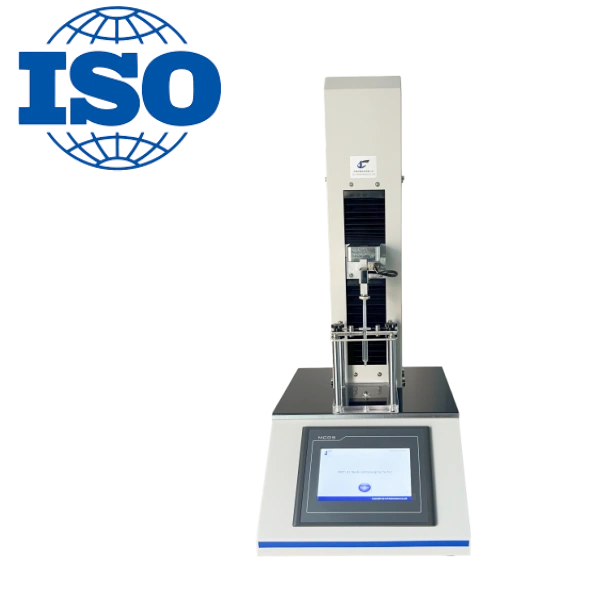
The MST-01 Medical Syringe Tester is designed for mechanical testing of syringes and includes functions relevant to piston force evaluation.
Key technical specifications include:
| Technical Parameter | MST-01 |
|---|---|
| Test Range | 50 N or customized |
| Test Speed | 1–500 mm/min |
| Stroke | 200 mm, excluding fixture |
| Displacement Accuracy | 0.01 mm |
| Accuracy | 0.5% F.S. |
| Control System | PLC |
| Interface | 7-inch HMI touchscreen |
| Data Output | Display, micro-printer, optional RS232 |
The 1–500 mm/min adjustable test speed allows the tester to accommodate different testing procedures and application requirements.
The 200 mm stroke also provides sufficient travel for many syringe piston movement applications, while customized fixtures can be considered for specialized syringe configurations.
Applications of Medical Syringe Tester
A medical syringe tester can support several stages of the syringe product lifecycle.
Medical Device R&D
Engineers can compare different piston stopper materials, barrel designs, lubrication conditions, and assembly configurations.
Manufacturing Quality Control
Manufacturers can use piston force measurements to monitor production consistency and identify changes between batches.
Pharmaceutical Packaging
Prefilled syringe systems require consistent mechanical behavior between the syringe components and the drug delivery process. Piston force testing can provide useful mechanical performance data during development and quality evaluation.
Material Evaluation
Different elastomer formulations and barrel surface conditions can produce different resistance characteristics. Glide force testing provides a quantitative method for comparing these combinations.
Failure Investigation
When users or production teams identify unusually high plunger force or inconsistent piston movement, force-displacement data can help determine whether the problem occurs during initial piston activation or continuous travel.
What Can Affect Piston Glide Force?
The measured piston force does not depend on the piston alone. Several factors can influence the result.
Piston stopper material: Different elastomer formulations can produce different friction and sealing characteristics.
Barrel surface: The internal surface condition of the syringe barrel affects the interaction between the piston stopper and the barrel.
Lubrication: Lubrication conditions can significantly influence piston movement and should be controlled during comparative testing.
Dimensional tolerances: Differences in piston or barrel dimensions can change the contact and sealing conditions.
Test speed: Changing the movement speed can affect the measured force. Therefore, the speed must remain controlled when comparing samples.
Alignment: Incorrect fixture alignment can introduce additional mechanical resistance and affect test results.
For this reason, repeatable fixture positioning and controlled test conditions are important for obtaining meaningful Syringe Sliding Resistance Test results.
How Can Test Results Support Quality Control?
A force test becomes particularly valuable when laboratories use it consistently across multiple samples or production batches.
For example, engineers can establish an internal reference range for:
- Break-loose force
- Peak force
- Average travel force
- Force variation during travel
If a production batch produces significantly different force characteristics from previous batches, engineers can investigate potential changes in materials, lubrication, component dimensions, or manufacturing conditions.
The force-displacement curve can also provide information that a single maximum force value cannot show. Two syringes may have similar peak forces while displaying very different movement stability.
Therefore, recording the complete test profile can improve the diagnostic value of the test.
Selecting a Medical Syringe Tester
When selecting equipment for an ISO 7886-1 syringe piston test, laboratories should consider the following factors:
- Appropriate force range
- Stable and adjustable test speed
- Adequate displacement range
- Accurate force measurement
- Accurate displacement measurement
- Reliable syringe fixtures
- Repeatable specimen positioning
- Force-displacement recording
- Data output capability
- Compatibility with the laboratory’s test procedure
- Possibility of customized fixtures
For laboratories testing different syringe sizes, special syringe designs, or related medical components, customized fixtures can be particularly useful.
Conclusion
A Medical Syringe Tester provides a controlled and quantitative method for evaluating syringe piston movement. The Syringe Piston Glide Force Test focuses on the mechanical resistance encountered when the piston starts moving and continues traveling through the barrel. By measuring break-loose force, peak force, and travel or glide force, engineers can obtain a more complete understanding of syringe operating characteristics and sliding resistance.
Accurate piston force measurement helps syringe manufacturers and laboratories understand sliding resistance, break-loose force, and glide force under controlled conditions. Cell Instruments provides the MST-01 Medical Syringe Tester with adjustable test speed, accurate displacement measurement, configurable force ranges, and customized fixtures for different syringe applications. Whether you are developing an ISO 7886-1 syringe piston test, investigating excessive plunger resistance, or establishing a production quality-control method, the right test configuration can provide reliable and repeatable mechanical data. Contact Cell Instruments to discuss your syringe testing requirements and customized solution.
 EN
EN  AR
AR  BG
BG  CS
CS  DA
DA  DE
DE  EL
EL  ES
ES  ET
ET  FI
FI  FR
FR  HU
HU  ID
ID  IT
IT  JA
JA  KO
KO  LT
LT  LV
LV  NB
NB  NL
NL  PL
PL  PT
PT  RO
RO  RU
RU  SK
SK  SL
SL  SV
SV  TR
TR  UK
UK  HE
HE  TH
TH  VI
VI